
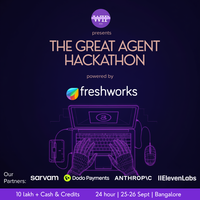
The Great Agent Hackathon
Women In Product India · The Great Agent Hackathon
Prize breakdown
Overall Winner
Cash + ₹30,000 in ElevenLabs credits + ₹4,70,000 in Dodo Payments credits
₹40,000Track 1 Winner
Cash + ₹ 2,30,000 Dodo payment credits
₹20,000Track 2 Winner
Cash + ₹ 2,30,000 Dodo payment credits
₹20,000Track 3 Winner
Cash + ₹ 2,30,000 Dodo payment credits
₹20,000Best Project on Eleven Labs
₹80,000 in credits This price can be combined with Track winner prize
Non-cashTop 20 teams
₹ 47,000 Dodo payment credits each
Non-cash20 winners
Timeline
- Submissions openJul 23, 2026
- Submission deadlineAug 30, 2026
About
The Great Agent Hackathon, presented by TGPF 2026
The Great Agent Hackathon is a 24-hour, in-person build happening overnight in Bangalore, as part of The Great Product Festival, India's largest product and startup conference.
Teams get real problem statements, real mentorship through the night, and a live Main Stage finale in front of India's top product leaders at TGPF.
This year's hackathon is powered by Freshworks as the title sponsor, with Dodo Payments, ElevenLabs, Sarvam, AWS, and Anthropic powering the build.
Problem Statement Tracks
-
Track 1 - Customer & Employee Experience: agents built on Freshworks Agent Studio, MCP, and multi-agent orchestration.
-
Track 2 - Platform Agent Skills & Knowledge: reusable skills, MCP integrations, and the Freshworks developer platform.
-
Track 3 - AI-native Enterprise (Open): open canvas, any stack, greenfield agentic products.
Examples
Track 1: Customer Experience & Employee Onboarding Agents
Voice Support Agent - handles a support conversation, identifies intent, takes actions and hands off to a human when needed.
Employee Policy Agent - answers HR/policy questions and proactively guides employees through relevant processes.
Track 2: Platform Agent Skills & Knowledge
Universal Company Knowledge Agent - connects Slack, docs, CRM, tickets and internal wikis to answer questions with context.
Knowledge-to-Action Agent - doesn't just retrieve information; converts company knowledge into actions and workflows.
Agent Handoff Skill - intelligently decides when one specialist agent should hand a task to another.
Track 3: AI-Native Enterprise Agents
AI Chief of Staff - monitors meetings, emails, tasks and priorities, then proactively drives follow-ups and decisions.
AI Operations Manager - monitors business metrics, detects anomalies and coordinates agents/teams to resolve them.
Autonomous Sales Agent - researches prospects, identifies intent, personalises outreach and manages follow-ups.
AI Finance Controller - monitors transactions, identifies anomalies, reconciles data and flags exceptions for human approval.
Requirements
Stage 1: Online Qualification Round
To qualify for The Great Agent Hackathon, teams must submit the following on Devpost before the qualification deadline:
- A Figma prototype or working demo of your idea addressing one of the 3 problem statement tracks. This does not need to be a finished product, a clickable prototype, wireframe flow, or early build is enough to show the idea clearly.
- A short written submission covering:
- The problem statement your team is addressing
- Your proposed solution and how it works
- Why your team is the right one to build it
- A brief video walkthrough (1-2 minutes) explaining your prototype and idea. Loom, YouTube, or Vimeo links are fine.
- Team details: names, roles, and one line on relevant experience for each team member.
Submissions will be reviewed by the TGPF and sponsor team. Shortlisted teams will be notified and invited to Bangalore for the in-person build.
Stage 2: In-Person Build (Bangalore, Shortlisted Teams Only)
Shortlisted teams travel to Bangalore for the 24-hour overnight build as part of TGPF 2026.
At this stage, teams must submit:
- A working prototype or demo of the product built during the 24-hour build window, functional and ready to demo live.
- An updated project description covering what was built, the tech stack used, and how it evolved from the original Stage 1 idea.
- Public code repository link (GitHub or equivalent) with a clear README.
- A live demo on the Main Stage in front of judges and the TGPF audience.
- Submissions open
- Jul 23, 2026
- Deadline
- Aug 30, 2026
- First seen
- Jul 23, 2026
- Last seen
- Aug 28, 2026